Generative AI for Healthcare Professionals: A Practical Introduction
A one-day, hands-on workshop for healthcare professionals who want to understand AI properly. You'll learn how large language models actually work, what the clinical evidence says about their use, and you'll build a working tool with AI agents. No technical background needed.
The same workshop, commissioned by hospital trusts, primary care teams, medical schools, research groups, and health-tech teams. Half-day and full-day formats, in person or online, with content tailored to your group's clinical or research focus.
Recently delivered for the South West London Training Hub and the UCLH GP training residential programme.
"Understanding the history of how these models came to be has changed how I see them… Great facilitation, great humour."
— Zehra Safdar, Chief Operating Officer, South West London Training Hub
"Justin makes the complex, ever-evolving topic of AI in healthcare engaging and informative — in a way that facilitates great discussion and interaction throughout. Our trainees thoroughly enjoyed all of the sessions."
— Dr Daniel Perelberg, Programme Director, UCLH GP Training Scheme
Healthcare professionals of any background, clinical or non-clinical, at any level. The day starts from first principles and assumes no technical knowledge — most people arrive knowing little about how these models actually work (attendees at a recent session rated their prior knowledge at 2.8 out of 5). Confident daily users still get plenty from the evidence and hands-on sessions, but nobody gets left behind.
It's probably not for you if you're after a technical course on model architecture, or a tour of commercial products. The format is a mix of teaching, discussion, and hands-on building, kept deliberately small so there's room for questions and conversation.
Previous attendees have included hospital consultants, GPs, surgeons, nurses, biochemists, research managers, and students. Resident doctors in London can usually claim the fee through NHSE's discretionary study leave route (guidance and forms on the PGMDE Support Portal); those training elsewhere should check their deanery's equivalent, and other professionals can often use their trust's CPD budget.
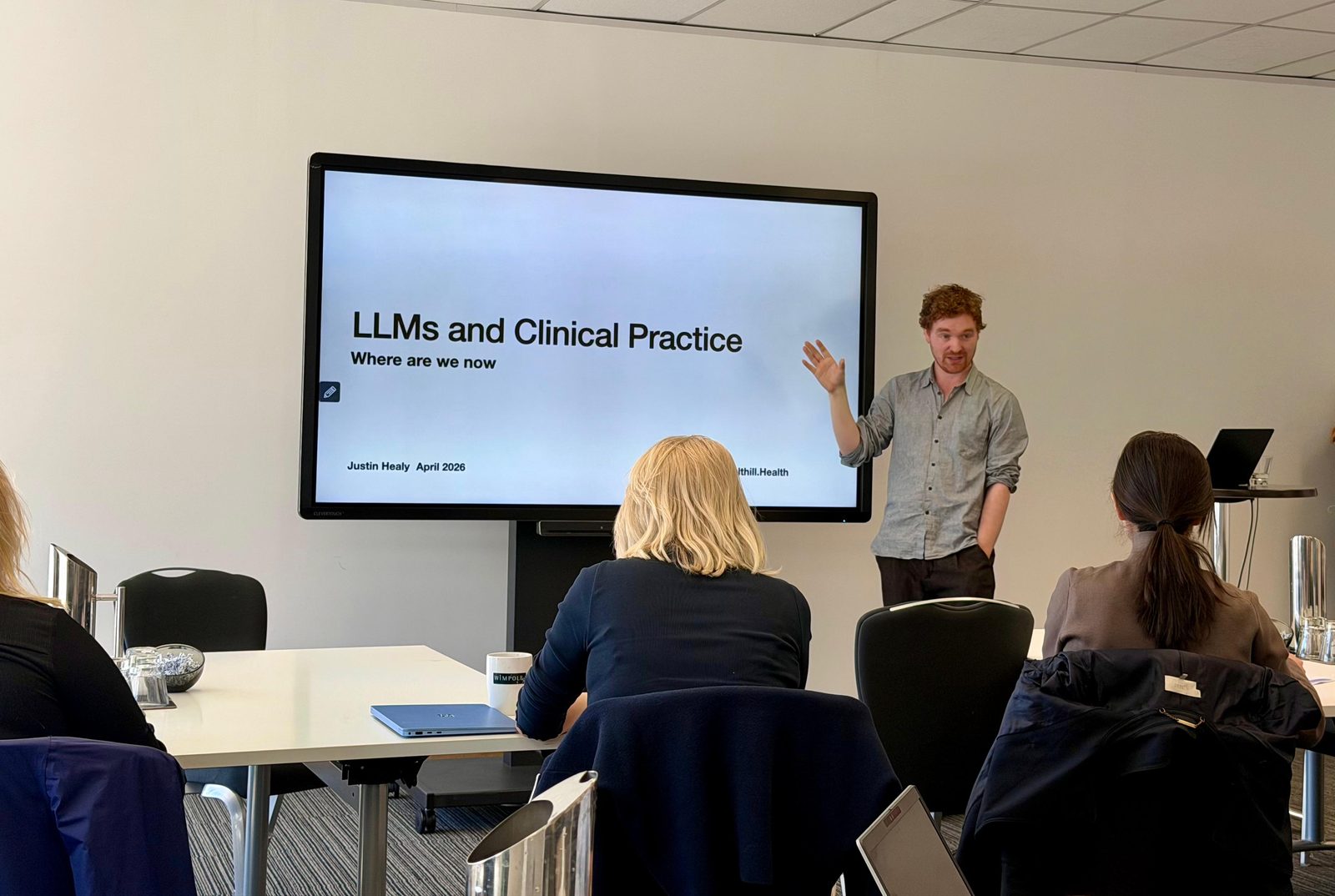
The April 2026 cohort, 1 Wimpole Street
This event has been accredited by the Royal Society of Medicine for 5 CPD points.
What you'll cover
How LLMs are built
Where ChatGPT and its competitors came from, how they're trained, and why that influences the answers they give.
The healthcare research so far
How LLMs perform in clinical scenarios, from laboratory studies to real-world patients, including the latest research on bias and harms.
Using AI tools today
How to actually get value out of these tools for your own work (writing, summarising, teaching prep, critical appraisal), and where they still fall short.
Build something with AI
A hands-on project using AI agents, run in small groups. Recent cohorts have built medical education games, clinic letter helpers, and clinical decision support prototypes. No technical experience needed.
Safety and governance
Privacy, bias, hallucinations, regulation, and where personal-tool use ends and clinical deployment begins.
The bigger questions
Small-group facilitated sessions on important challenges that AI poses: what to teach future clinicians, what should regulators consider, what this all may mean for patients and the NHS.
Programme
9:30Introductions
9:45How large language models are built
10:30Coffee
10:45LLMs in clinical practice: the evidence so far
"It gave me confidence to expand use of AI for work. It was great to practice building a game, and it generated lots of ideas for future application."
— Workshop participant, July 2026
"Pitched at a level that all enjoyed. Interesting, relevant and very clearly presented."
— Workshop participant, July 2026
"Explaining complex stuff in an easily understood way, being interactive — I really enjoyed the practical session."
— Workshop participant, April 2026
"The perfect blend of technical and philosophical — communication style is perfect for a course of this nature."
— Workshop participant, January 2026
Participants have ranged from experienced professionals who'd never touched an LLM to new graduates using them every day.
The facilitator
Dr Justin Healy
Dr Justin Healy is a GP and hospital doctor at University College London Hospital, where he is chief investigator on several generative AI studies at the UCL Institute of Health Informatics. His research focuses on how large language models perform in real clinical settings.
Before moving into clinical informatics, he spent five years with Médecins Sans Frontières as a medical project manager across seven countries. He studied medical ethics at Manchester University, and public health at Harvard University.
On the day
What to bring
A laptop with a web browser. There's no need to download any extra software.
No patient data. The practical work uses fictional and public examples only.
No preparation. The workshop starts from first principles.
1 Wimpole St is a short walk from Oxford Circus. Plenty of food options nearby.
Hear about the next one
Booking is open for 27 October. Workshop dates and occasional writing on medicine and machines go out through Incidental Finding — new dates are announced there first.